
Leading with Depth and Height: What Courage Looks Like in Leadership
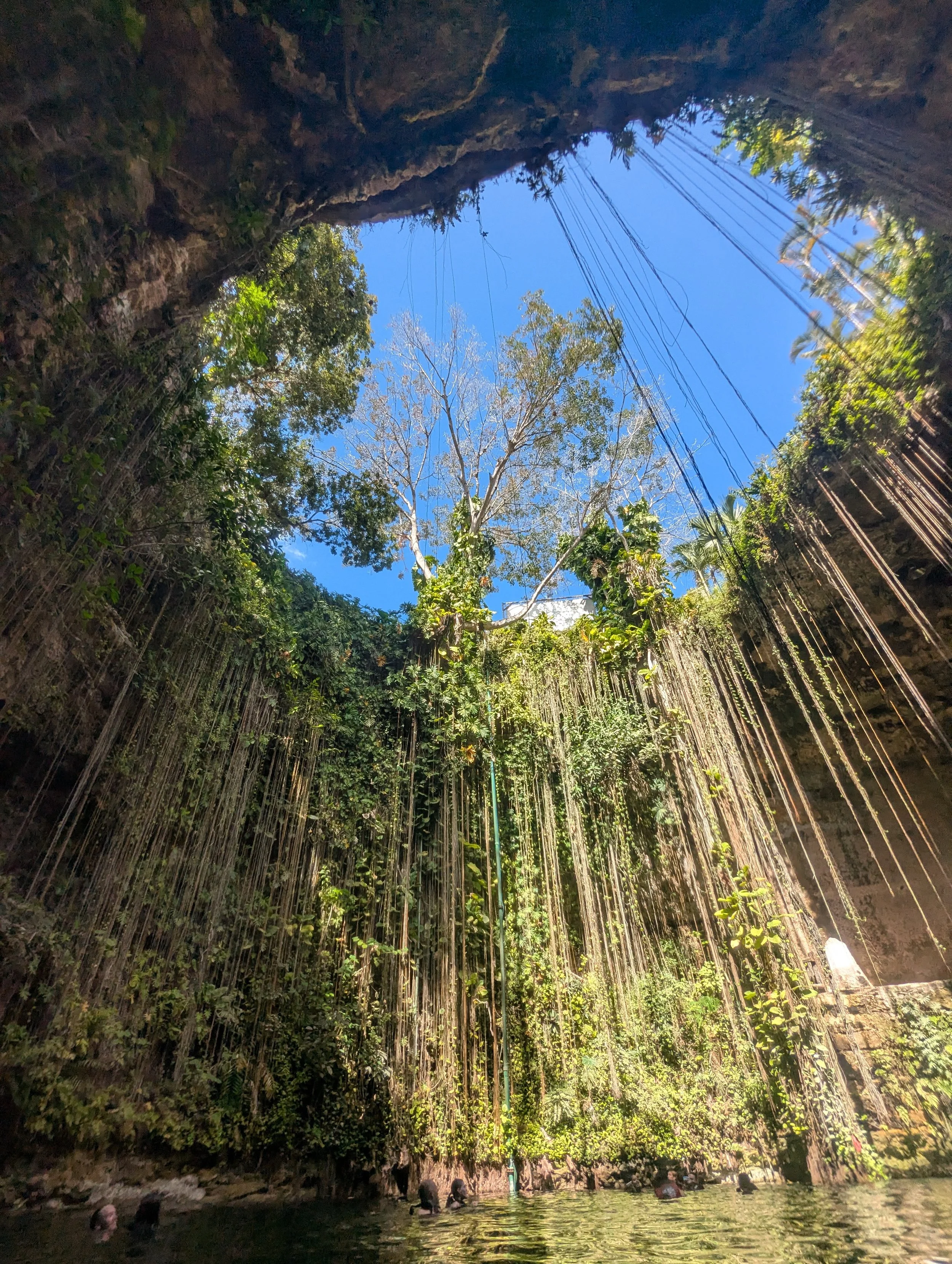
This week in the Yucatán, I experienced two powerful contrasts in the same day: the depth of Cenote Ik Kil and the height of the ancient Maya ruins at Ek Balam. One invites you to look down into clear water more than 100 feet deep and decide whether to step off a stone platform into open space. The other asks you to look up at limestone structures rising above the jungle canopy and decide how far you are willing to climb.
Both are breathtaking. Both are optional. And both reveal something essential about courage in leadership.
At Ik Kil, I watched people make very different choices. Some never entered the water at all. They stood at the rim, fully present to the beauty from solid ground. Others descended the steps and sat at the edge, dipping their feet in but going no farther. Some eased themselves in slowly, staying close to the wall and adjusting to the cool depth. Others stepped onto the platform and leapt fully into open water, committing in one bold movement.
The same cenote. Different approaches. No single right way to experience it.
Later, at Ek Balam, I saw the same range of responses unfold on stone. Some visitors admired the ruins from below. Some began the ascent and moved carefully, placing each foot with intention on the steep steps. Some climbed halfway and paused.
I climbed part of the way up. Not to the top. Heights challenge me. My husband climbed all the way and later showed me photographs of the view stretching over the treetops of the surrounding jungle. His experience was expansive in one way. Mine was expansive in another. I stretched beyond what felt easy without pretending I did not have limits.
Same structure. Different responses. All valid.
Leadership looks exactly like this.
In every organization, people vary in their willingness and speed to take risks, embrace change, speak up, or step into visibility. Leading through change often requires both depth and height. Some leap. Some test the water. Some climb steadily. Some move part way and reassess. Some observe before engaging.
The mistake leaders sometimes make is assuming there is only one correct pace or one proper expression of leadership courage.
At the cenote and at the pyramid, what mattered was not speed or spectacle. What mattered was engagement. What mattered was presence. What mattered was choosing to stretch in a way that aligned with who you are.
Leadership requires both depth and height. It asks us to step into situations where we may not feel steady and to rise high enough to gain perspective. But it also asks us to recognize that courage is not uniform. Boldness is not superior to caution. Speed is not superior to steadiness. Partial progress is still progress.
Our role as leaders is not to demand that everyone leap from the platform or sprint to the top. It is to create environments of psychological safety where people feel secure enough to participate in their own way. Where steady climbers, bold leapers, and thoughtful observers all belong. Where stretching is encouraged but comparison is not.
The ancient Maya built structures that still stand centuries later. They also built communities sustained by deep water sources hidden beneath the surface. Height and depth worked together.
Leadership works the same way.
Height expands vision.
Depth builds resilience.
Presence makes both meaningful.
Leadership growth happens when we honor different expressions of courage while building environments where everyone can rise, in their own way.
© 2026 Center for Dynamic Knowledge. All rights reserved.
This content is the intellectual property of Center for Dynamic Knowledge and may not be reproduced or shared without permission.